Let's have a chat!
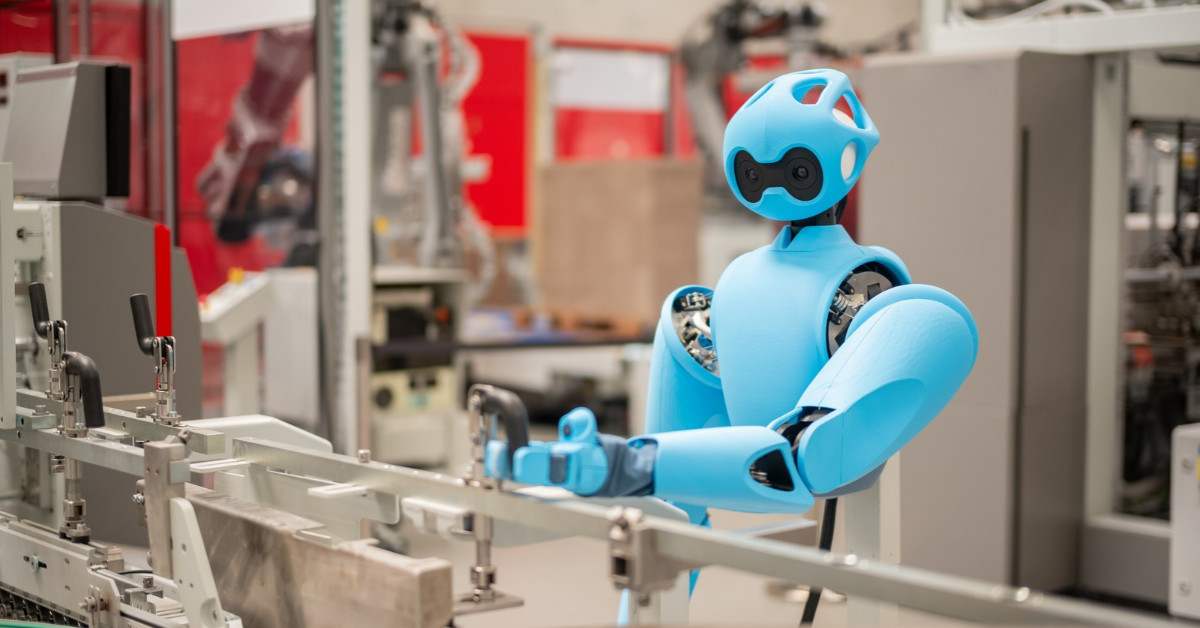
Look AI Ventures portfolio company Embodied AI, a Swiss EPFL spin-out, unveiled its first humanoid robot, AIR, at Humanoid Europe 2026 in Munich on 6 November 2026. AIR is designed to work right next to people on the production line, without a safety cage.
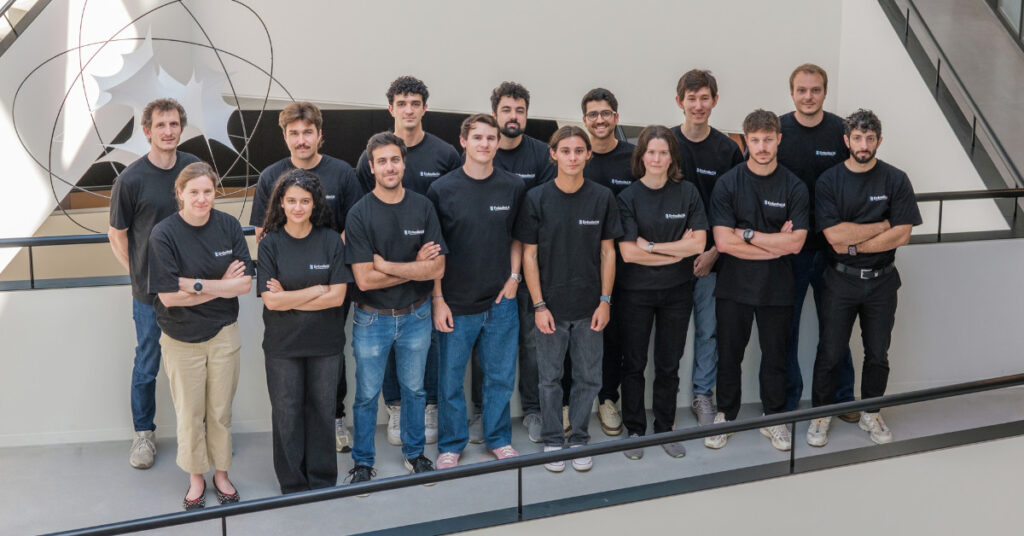
Tesla and Figure AI are pouring billions into humanoid robots. Embodied AI, a 25-person startup from Lausanne, is taking a different route: instead of betting on one giant general-purpose robot brain, it puts a safe robot on the production line now, makes it useful from day one, and lets it learn the job as it works.
CEO Francesco Stella presented AIR at Humanoid Europe 2026 in Munich.
AIR is a humanoid robot with a body and two arms on a wheeled base, built for manual, high-variation tasks that conventional industrial robots can’t automate. Factories across Europe still do many of these tasks by hand, and they are increasingly short of workers to do them.
Most industrial robots are too heavy and rigid to work near people, so they are kept behind fences or other safety barriers. AIR is designed differently:
AIR runs on the same AI stack that is already doing paid work on a customer’s production line in Embodied AI’s two-arm robot cell. In paid pilots with large manufacturers, including a leading consumer electronics manufacturer and a global automotive and industrial technology supplier, Embodied AI’s robots reach an average success rate of 95%.

“Physical AI has a safety problem. Most robots built for factories are too heavy and too rigid to share a line with people, so they end up behind fences (and that’s a big problem). Embodied AI took the opposite route: a 2 kg tendon-driven arm that lifts 5 kg, deployed in one week and reaching an average 95% task success rate within a month. Safety by design, not by distance. That’s why we backed the team at Embodied AI,” said Angelo Burgarello, Partner at Look AI Ventures.
Embodied AI is a spin-out of EPFL, headquartered in Lausanne, Switzerland, with an office in Rome. It is led by 28-year-old CEO Francesco Stella, who earned his PhD in robotics at EPFL, did research at MIT, and was featured in Forbes Italia’s Under 30. His co-founders are CTO Kai Junge, who trained at Cambridge and EPFL, and COO Max Polzin, previously a tech lead at Seervision, a startup later acquired by Q-SYS.
The company is backed by an international group of investors including Faber VC, Look AI Ventures, Techshop Capital, Vento, Plug and Play, Kickfund, and Excellis.

“If an AI system recommends the wrong product to you, nobody gets hurt. But if a robot makes a mistake and hits someone, obviously you don’t want that,” said Francesco Stella, Co-Founder and CEO of Embodied AI. “That’s why we developed robots that are physically safe, useful from day one thanks to teleoperation, and autonomous within a month thanks to our own AI stack.”